Gamification: Introduction (Part 1 of 6)
JannaDougherty
News
In recent years, pedagogical circles have been buzzing with a concept commonly summarized as ‘the gamification of education.’ Classrooms all over America have started experimenting with gamification, trying out new systems and developing new content approaches to get their kids engaged. Unfortunately, many educators are unclear on what this phrase means, and as a result come down on the idea rather harshly when it doesn’t seem to work.
Some critics believe that it will create students who are only finishing tasks to ‘win points’ or ‘have fun,’ rather than for the sake of learning. These critics will often state that a gamified classroom will lead to entitled, distracted students with short attention spans and little knowledge of the subject they are supposed to be learning.
Others confuse gamification with playing video or computer games in the classroom, and say that some topics just can’t be taught that way.
Still others argue that in its current form, gamification in education takes the parts of games that people care about the least, and confuse them for core ideas that keep kids learning and progressing. These detractors state that attempts to gamify classrooms are easily seen through by students. In short, the additions meant to motivate, don’t.
Some of these are valid criticisms, while others are based on a misunderstanding on what gamification actually is. As a result, we’ve decided to run a short series on the subject of gamification, and explore how technology can be used to implement the principle properly in a classroom setting. We’ll point out examples of gamification done wrong, and propose ways these tools can help fix those misconceptions.
Before we start, though, let’s be clear: ‘gamification’ and ‘game-based education’ are not the same principles, although they are often found used together.
‘Gamification’ refers to the use of game design principles when setting up a system like a classroom. It involves thinking about the psychology of motivation, competition, and collaboration. With these ideas and elements commonly found in games, teachers then create situations where students become more motivated to learn and progress. Gamification applies when thinking of structures like classroom management, differentiation, and assessment—how they are approached and implemented with your students. This will be our focus throughout the series. As we discuss the various possibilities, we’ll include examples of digital tools that have made a positive use of gamification rather than games.
‘Game-based education’ means to literally use games to teach or test content. The most famous example of game-based education is the infamous Oregon Trail game, which was used to help teach students about western pioneers and America’s westward expansion. Many of these games take advantage of gamification to an extent, but the emphasis is that they literally embed learning experiences into already-existing games, taking advantage of the ‘fun’ they already display. While our focus won’t be on game-based education in this series, we will make a point in our last installment to touch on how it can be updated and improved for modern schools.
We’re excited about this series, and we hope that you’ll be excited to join us on this exploration of a new concept in education. But, before we plunge headlong into the depths, I’d like to make one observation, in response to some of the critics of gamification:
You’ll almost never meet a student who actually wants to learn something for its own sake.

Even my smartest students, the ones who actively desired new knowledge and absorbed it like a sponge, were seeking out learning experiences as a means to an end. In fact, almost every kid I’ve ever met who wanted to learn something had a reason for it. From the high school senior taking a coding course so she could eventually make her own fighting game, to the middle school boy reading every sci-fi book in the library in the hopes that he’ll figure out how to build a hovercar, to the kindergartener learning the alphabet just because she wants to write her own name—they all had a context that their desire was based in.
And that’s ok!
Knowledge is only useful in the real world with a framework in which to use it, and I think kids know this instinctively. It’s why the most common questions they ask is ‘why?’ or ‘what for?’ There’s nothing wrong with using technology and gamification to play on this instinct, and if anything, acknowledging that can only make us more effective teachers.
We hope you’ll join us throughout this series on the applications of gamification in the classroom. As we go through the parts listed below, please provide your own ideas and experiences with games and gamification in the comments. After all, education is a community!
Part 1: Introduction
Part 2: Pavlov and Classroom Management
Part 3: Rethinking the Grading Process
Part 4: Class Systems in the Classroom
Part 5: Games and Curriculum
Part 6: Conclusion and Resource List
One thought on “Gamification: Introduction (Part 1 of 6)”
Leave a Reply
You must be logged in to post a comment.
Related Articles & Other Recommended Reading
Bridging the Gap to Successful Project-Based Learning with Inspirit
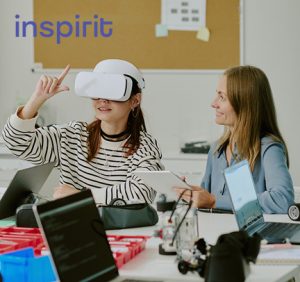
There is no better way to complement your Project-Based Learning (PBL) initiatives than by creating engaging and interactive experiences in virtual reality (VR). VR provides users with a computer-generated simulation of a 3D image or environment that can be interacted with in a seemingly real and physical way. Inspirit offers user-friendly, innovative VR headsets that […]
Teq is Headed to FETC!
Teq is off to the 2026 Future of Education Technology Conference (FETC)! Being held from January 11th to January 14th, 2026, this top-notch event is being hosted at the Orange County Convention Center in Orlando, FL! Demo innovative products, grab some swag, or say hello to the team at booth #2730. Tune in to interactive […]

Introducing the New AI Literacy and Instruction Micro-credential!
The landscape of K-12 education is rapidly evolving, driven by the emergence of Artificial Intelligence. Educators and administrators need more than just introductory knowledge; they need a structured, practical path to mastery. We are excited to announce the launch of the AI Literacy and Instruction Micro-credential Playlist! This comprehensive, seven-session video series is designed specifically […]
Looking forward to reading the rest of the series!