Great Ways to Utilize Breakout Rooms
Terry VanNoy
PD Specialist
News

When classroom teachers meet virtually with their students, they now have a number of ways to implement breakout rooms within popular platforms like Google Meet, Zoom, and Microsoft Teams.
Breakout rooms offer an opportunity for students to work in smaller groups to accomplish tasks, have discussions, or work together on projects or homework.
Rather than discuss the how of breakout rooms, though, this blog is about the why. Once you have a platform that offers this tool, what can you do with it? How can you leverage it for your students’ benefit?
Below you will find some great ways teachers can utilize breakout rooms with both students and fellow teachers.

Homework help
- The teacher meets with all students first for direct instruction or to review concepts.
- Next, students are put into breakout rooms for a set amount of time to work on the current homework assignment. The teacher can split them randomly, but a more effective method is to use one student to be a leader in each room for assistance. These leaders are there to answer questions and can rejoin the teacher in the main room if needed for short periods of time.
- Using a shared document or a Jamboard/whiteboard, the teacher can visit each room to check on things and answer any questions from the group.
- After a specified period of time, all students will report back to the main room with the teacher.

Faculty meetings
- Administrators meet with the group first for announcements and expectations.
- Then, breakout rooms can be created for committees, task forces, level, or subject matter. The meeting host(s) can remain in the main room for general questions from people jumping in, or they can visit each breakout room for support.
- At the end of the designated time, teachers can rejoin the main room and share their work or report back to everyone.
Icebreakers
- After meeting together, the teacher sets up breakout rooms. Each room will be named by the icebreaker task they need to accomplish. Students in each room will complete a task and be ready to report back to the larger group at the end of the time slot given. Click here for some icebreaker ideas.
- The teacher will share the task instructions from a shared Google doc; the link will be put in the chat box for each small group.
- At the end of the small group time, the teacher will ask a representative of each group to share their work or explain how they did on the task.
Workspaces
- When the teacher breaks everyone into small groups, students will have an option of being in a quiet room or a collaborative room to get some work done.
- Students in a collaborative room will need to make sure they get the work done and are allowed to have microphones on to discuss things as needed. If they get stuck, they are allowed to visit the teacher in the main room for help. Then, they’ll pass on what they’ve figured out to their small group.
- Students in the quiet room will work mostly muted but can visit the teacher in the main room for help if needed.
- All groups must be ready to have the teacher visit and check in every few minutes during the work period.

Presentation showcase
- Students are put in breakout rooms based on their project groups. Their task is to work on and practice their classroom presentation.
- At the end, the teacher will randomly ask groups to present to the larger group (or ask for volunteers).
Jigsaw groups
- Each small group will be given a task to work on. These tasks will be related and the process/solutions will be shared back to the group. An example would be a series of math problems that are similar. Each group would solve them and share with the larger group how they thought through the problem.
- Alternatively, each group could be given the same problem to solve. Each group has to explain why their method is the best one. Some ideas include: multiple step math problem solving, persuasive argument letters or advertisements, designing a product using engineering principles, etc.
- During the work time, teachers can visit each group to answer questions. Optionally, student leaders or spokespeople for each group can visit the teacher in the main room for help.
Writer’s workshop
- As students are drafting their writing projects, there may come a time when they need some support and ideas from their peers. The teacher can break the class into smaller groups where each student will share a piece of their writing.
- Groups should be no larger than four or five students, and the teacher should already have modeled the process or protocol for the sharing and feedback steps with the class beforehand.
- During the group time, students take turns reading their pieces aloud and at the same time, if possible, sharing their drafts with a link in the chat box. The other students listen, offer suggestions and feedback, and even add digital comments to the writing as a collaborative file.
- Alternatively, students could use this model to get help with script writing, story writing, debate preparation, etc.
Please share any other lesson ideas and breakout room models that you have used or have thought of! Breakout rooms can be a very powerful tool in your virtual classroom teaching this year, and we hope these ideas help you utilize them to their fullest.
For more tips, tricks, and tools for teaching in and out of the classroom check out more articles on our blog.
We also offer virtual professional development, training, and remote learning support for educators with OTIS for educators. Explore the technology, tools, and strategies that can spark student success — no matter where teaching or learning are happening.
0 thoughts on “Great Ways to Utilize Breakout Rooms”
Related Articles & Other Recommended Reading
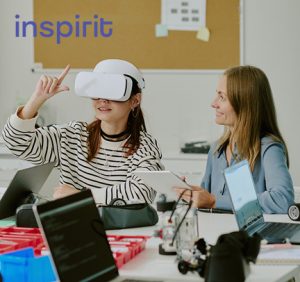
Bridging the Gap to Successful Project-Based Learning with Inspirit
There is no better way to complement your Project-Based Learning (PBL) initiatives than by creating engaging and interactive experiences in virtual reality (VR). VR provides users with a computer-generated simulation of a 3D image or environment that can be interacted with in a seemingly real and physical way. Inspirit offers user-friendly, innovative VR headsets that […]

Teq is Headed to FETC!
Teq is off to the 2026 Future of Education Technology Conference (FETC)! Being held from January 11th to January 14th, 2026, this top-notch event is being hosted at the Orange County Convention Center in Orlando, FL! Demo innovative products, grab some swag, or say hello to the team at booth #2730. Tune in to interactive […]

Introducing the New AI Literacy and Instruction Micro-credential!
The landscape of K-12 education is rapidly evolving, driven by the emergence of Artificial Intelligence. Educators and administrators need more than just introductory knowledge; they need a structured, practical path to mastery. We are excited to announce the launch of the AI Literacy and Instruction Micro-credential Playlist! This comprehensive, seven-session video series is designed specifically […]