Tips for Introducing Coding to Your Early Elementary Classroom
Emily Martin
EmilyMartin
News

“Not only is it important for children to start programming at a young age to prepare them for the booming computing workforce, but more importantly, coding provides a systematic way of thinking and language expression and communication. While coding, children learn to become better problem solvers, mathematicians, engineers, story tellers, inventors, and collaborators.” [1]
Introducing… Coding!
Many educators wonder when – and more importantly how – to start introducing coding into early education. To help you tackle planning and implementing an early elementary coding program, we have listed some tips below.
Start with a 3:1 Ratio
When introducing any coding product in early elementary classrooms, we suggest breaking your students up into smaller groups of three to encourage teamwork and collaboration. There are many solutions that help illustrate coding concepts (like sequencing and debugging), while also encouraging sharing and teamwork.
KIBO, a robot kit specifically designed for young children aged 4-7, gives students the chance to work in groups to build, program, and decorate their very own robot. KIBO is made up of wooden blocks – objects that are familiar and comfortable to young children. The KIBO robot enables students to “encounter concepts such as number, size, measurement, distance, and time” all while “learning and applying new vocabulary words” and “communicating with teachers and peers.” [2]
Another example is Botley The Coding Robot. Botley can be introduced to children as young as five, and has the ability to grow with them during their elementary years. It comes ready-to-use out of the box and includes 77 additional pieces such as coding cards, games, and interactive obstacles. Children have the ability to code Botley up to 120 steps using if/then logic to get Botley to execute an obstacle course, follow a self-made maze, and more.
An added bonus? Both KIBO and Botley are small enough that they do not require a designated Makerspace. Your students can work with them in your existing classroom space.
Don’t Worry About Screen Time
A common concern when implementing any coding program is that it will require a lot of screen time. Luckily, there are plenty of robots that don’t require the use of a screen at all. Solutions such as Cubelets by Modular Robotics and Ozobot’s Evo and Bit offer a screen-free solution for students to experience coding, programming, and design thinking.
Cubelets are individual blocks that snap together with magnets to create different types of robots. Each block is pre-programmed with a special skill. The blocks are then combined to build various robots with a multitude of behavior combinations. Students learn the basics of programming logic and troubleshooting, all without learning a single line of code. As they advance, they can apply these computational thinking skills to traditional programming in Blockly or C++.
With Ozobot, students learn how to code through drawn lines and color codes. When Ozobot detects unique sequences on colors, it is pre-programmed to perform different actions or change behavior. There are over 25 unique code commands to control Ozobot’s speed, decision-making, and behavior. Children are able to use their creativity – all while developing logical reasoning.
Integrate into Your Existing Curriculum
Choosing age-appropriate resources that will grow with your students can help you achieve curriculum integration across grade levels. Products such as Sphero, Wonder Workshop, and SparkFun all offer a progressive coding curriculum, so your students can continue to build upon their skills year after year in all subject areas. For example, Sphero’s Sphero City activity is specifically designed to integrate coding into a K-2 social studies classroom. Students are first tasked with recreating a city from history using low-tech materials. Then, they program Sphero to take a tour through the town while making stops at particular landmarks. Students can then take the programming and historical knowledge they’ve gained and build on it in future classes.
Changing How We Think About Introducing Coding
Introducing robotics into the early elementary classroom can seem daunting at first, but it doesn’t have to be. When you believe that coding is “a way to achieve literacy in the twenty-first century” [3] it becomes something impactful and essential.
For help implementing coding into your curriculum, contact our PD team at onlinepd@teq.com
[1] Coding as a Playground: Programming and Computational Thinking in the Early Childhood Classroom by Marina Umaschi Bers
[2] Ibid.
[3] Ibid.
0 thoughts on “Tips for Introducing Coding to Your Early Elementary Classroom”
Related Articles & Other Recommended Reading
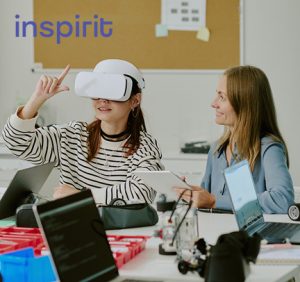
Bridging the Gap to Successful Project-Based Learning with Inspirit
There is no better way to complement your Project-Based Learning (PBL) initiatives than by creating engaging and interactive experiences in virtual reality (VR). VR provides users with a computer-generated simulation of a 3D image or environment that can be interacted with in a seemingly real and physical way. Inspirit offers user-friendly, innovative VR headsets that […]
Teq is Headed to FETC!
Teq is off to the 2026 Future of Education Technology Conference (FETC)! Being held from January 11th to January 14th, 2026, this top-notch event is being hosted at the Orange County Convention Center in Orlando, FL! Demo innovative products, grab some swag, or say hello to the team at booth #2730. Tune in to interactive […]

Introducing the New AI Literacy and Instruction Micro-credential!
The landscape of K-12 education is rapidly evolving, driven by the emergence of Artificial Intelligence. Educators and administrators need more than just introductory knowledge; they need a structured, practical path to mastery. We are excited to announce the launch of the AI Literacy and Instruction Micro-credential Playlist! This comprehensive, seven-session video series is designed specifically […]