The Importance of Reflection in Education
JessicaWenke
News

Self-reflection has become a habit of mine…
…and it all started while I was working on my Master’s in Science Education. During this time, my favorite professor did a fantastic job of instilling this habit in me and my peers by requiring self-reflection after almost every assignment he graded. We would ask ourselves questions like, “Could I have phrased this differently to convey a more desirable meaning,” or, “How can I restructure this lesson to better reach some of my struggling learners at their level?”
I soon realized that I was carrying this process into other aspects of my life other than teaching and academics. I constantly sought to discover how I contributed to any events that may have been emotionally heightened in any way, good or bad. I feel that this skill has brought me peace and understanding in many ways throughout my life and teaching career and I am grateful for it.
Reflection in Training
Recently I assisted in facilitating a #NYCSchoolsTech Teq Certification on Design Challenges and 3D Printing in NYC. I found that reflection was a theme throughout this training and continued on after all of the attendees went home. Design challenges are open-ended projects that encourage students to ask questions, take initiative, think creatively, and reflect.
When starting a design challenge, it is a best practice to share a form of the engineering design process with one’s students and practice it with them. This process can look different depending on classroom climate and the expected outcome of any given design challenge.
In our training some teachers revealed that they were using the Ask, Imagine, Plan, Create, Improve process, and others were using the Brainstorm, Design, Prototype, Reflect process. We provided our example of Design, Build, Test, Learn. Want to know the best part about all of this diversity in the engineering design process? All the versions are right!
Just like the engineering design process described above (in 3 different ways), often trainings and lessons aren’t liner— they’re cyclic. I cannot stress the value of reflection enough when learning new technologies and techniques. All the attendees of this training did a fantastic job of evaluating what they are currently doing inside the box in terms of STEM education and thinking outside of it when it came time. As I continue to reflect on this training I think about how constructive open communication between peers can be, and in this case it lead to quality collaboration. I also, think about some ways we could have improved this training, and that might be the part that deserves the most attention. It’s humbling to remind oneself of this and to rethink an idea after testing. There’s value in not getting things right the first time.

Findings in Reflection
For this training we could have stressed that failure is ok, in fact it’s welcomed! When learning about 3D printing and design challenges there are going to be point of frustration and instead of crumbling in the face of that we should tackle it head-on. Our attendees did an excellent job of powering through their frustrations, however, we could have and always can offer more support in this area. Another improvement could have been the overall structure of the lesson. Breaking attendees into small groups based on skill level and offering differentiated activities would have gone a long way.
Overall, we received positive feedback on this training and I am happy to have been a part of it and have had the chance to work with such an open and passionate group of teachers. I encourage you to reflect more if you aren’t already and test out the engineering design process in all aspects of your life you think it may apply. You may be surprised by what insights it gives you!
0 thoughts on “The Importance of Reflection in Education”
Related Articles & Other Recommended Reading
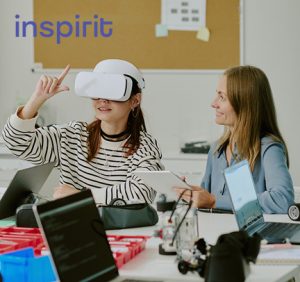
Bridging the Gap to Successful Project-Based Learning with Inspirit
There is no better way to complement your Project-Based Learning (PBL) initiatives than by creating engaging and interactive experiences in virtual reality (VR). VR provides users with a computer-generated simulation of a 3D image or environment that can be interacted with in a seemingly real and physical way. Inspirit offers user-friendly, innovative VR headsets that […]
Teq is Headed to FETC!
Teq is off to the 2026 Future of Education Technology Conference (FETC)! Being held from January 11th to January 14th, 2026, this top-notch event is being hosted at the Orange County Convention Center in Orlando, FL! Demo innovative products, grab some swag, or say hello to the team at booth #2730. Tune in to interactive […]
Introducing the New AI Literacy and Instruction Micro-credential!
The landscape of K-12 education is rapidly evolving, driven by the emergence of Artificial Intelligence. Educators and administrators need more than just introductory knowledge; they need a structured, practical path to mastery. We are excited to announce the launch of the AI Literacy and Instruction Micro-credential Playlist! This comprehensive, seven-session video series is designed specifically […]