5 Strategies for Falling Back in Love with Teaching
Emma Foley
Senior Curriculum Specialist
News
Many educators aren’t ready to fall out of love with teaching, and are not ready for this chapter of their life to be over yet. However, they feel a certain way about getting up and doing the same thing in their post-pandemic classroom day after day. After reading a lot of articles and listening to podcasts from former and current educators, I have learned that instead of thinking about how your attitude towards teaching has changed, shift your thinking towards why the teaching profession has stopped bringing you joy. In other words, use this time to acknowledge where you are and check in with yourself.
From the perspective of both a former special education teacher and a current curriculum writer, here are some simple activities that can help shift your mindset and possibly reignite your passion for teaching.
1) Stop worrying about the “curriculum police”
Take advantage of the ability to loosely connect those more exciting lessons to your curriculum and stop always fearing that the curriculum police are going to come knocking at your classroom door. There is something to be said about a principal who has your back, so if you have one, take advantage of them! Use your freedom to create engaging learning experiences for your students (as long as you are meeting even just a few of the grade level standards). Make your purpose for that lesson clear to whoever you need to be your cheerleader (usually your principal who is the one doing observations). One of the easiest selling points is: yes, all students need to learn to read and do math, but they also need mental health and SEL support.
You can also advocate for yourself and switch things up by including something along the lines of “I am doing this lesson on __________ instead because my students are going to be engaged and also learning about _________,” when meeting with your administrator pre or post observation.
2) Taking learning outside the classroom
For many of us, warm weather is right around the corner. This is the perfect opportunity to get your students outside and let them have fun while learning. This has the potential to take a lot of the pressure off of you and it just might improve the overall behavior of your class.
For example, if you’re working with younger students, consider taking them outside to practice phonics/letter formation on the pavement. For slightly older students, you could set up a puppet theater outside in the schoolyard and have students practice their narrative story elements by putting on a puppet show, reinforcing what they have learned about key details and sequencing. Another great option for elementary and middle school students is to get students outside to learn about the sun, moon, stars, and planets. Our elementary project-based learning iBlock, Space Systems: Light and Shadows, is a great opportunity to get students outside the classroom and task them with engineering their own time-telling device such as a sundial. To learn more about PBL and iBlocks, check out our full library of topics on iBlocks website.
For teachers, taking learning outside of the classroom or school building may include attending STEM and other education conferences. Attending an education conference is an opportunity to learn about new strategies that can help you feel more empowered in your teaching. Also, being in a different setting, surrounded by other educators just might reignite your love for teaching. I personally always feel a different way about education after returning back from a few days out of the office, especially when I am representing Teq at a conference.
3) Model self-awareness by example
We are constantly encouraging our students to be aware of their mindset and stress levels. Let’s face it, no matter what age group of students we are working with, they learn by example. We also need to be aware of our own mindsets and stress levels, so why not explicitly show students how we are staying in tune with our own mental health?
For beginners, model deep breathing during high stress situations. Share explicitly with your students who you choose to surround yourself with and why (maybe highlighting a particular colleague’s ability to reassure and refresh). Moments like these can be beneficial to your students and also help you become more aware of your social and emotional well-being.
4) Avoid a working lunch
If you are one of the lucky teachers to have a duty-free lunch, you might be surprised to learn that not all teachers have duty-free lunch or planning breaks protected by law. Education, unlike other professions, requires educators to be on their feet for most of the day and to be “on” for hours at a time. When lunch time rolls around, teachers would love to use that time to power down and reflect, but shutting your brain off like that is easier said than done. Most teachers use their lunch period (whether 45 minutes or an hour) to use the restroom, answer parent emails, do last minute lesson planning, etc.
In my own experience, especially after many years spent in a self-contained special education classroom, teaching can be very isolating. Sometimes you just need to connect with people your own age to share some of your frustrations or proud moments. As previously mentioned, being strategic about who you surround yourself with is extremely important because you want to find colleagues who raise you up. Using your lunch period to reconnect with other adults, take a “brain break,” vent a frustration, or chat with friends isn’t “slacking.” It can be essential for your mental health. Even if you choose to spend your lunch period alone, be sure you don’t cave into the temptation to get work done. Instead, do something that will help you relax, re-focus, and be the best version of yourself for when you have to go back to the classroom.
5) Get up just a little bit earlier
While it might sound unappealing at first, starting your day just a bit earlier can be so beneficial. Getting up at 5AM to give myself some “me-time” before I spend hours in front of the computer, preparing materials about all things education, has been a game-changer. For many educators, looking at books and other curricular material doesn’t stop at the end of the work day, so finding time for “me-time” after work might be hard. Not everyone’s “me-time” looks the same. You might use that extra time in the morning to plan out the day, get in a quick workout, or eat a relaxing, well-balanced meal. Whatever your me-time looks like, starting your day on a positive note can set you up for a positive work day ahead, no matter what the day has in store.
If you are looking for a way to love your profession again, my advice to all teachers is to trust yourself. In almost every conversation I have with other educators, I always say you know your students best, and you also know yourself best. Part of maintaining stamina in the education field is all about knowing when you are in a bad place mentally, and being okay with tending to that first! To learn more about educator mental health and other SEL suggestions, check out our course offerings on our online professional development platform, OTIS for educators.
For more tips, tricks, and tools for teaching in and out of the classroom, check out more content on the Teq Talk blog or our YouTube channels OTIS for educators and Tequipment.
We also offer virtual professional development, training, and support with OTIS for educators. Explore the technology and strategies that spark student success — no matter where teaching or learning are happening!
Follow us on social:
 edteq
edteq  OTIS4educators | Teq Products | iBlocks
  OTIS4educators | MyTeq
  Teq
Teq
0 thoughts on “5 Strategies for Falling Back in Love with Teaching”
Related Articles & Other Recommended Reading
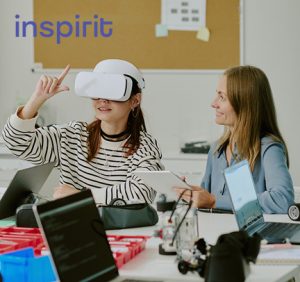
Bridging the Gap to Successful Project-Based Learning with Inspirit
There is no better way to complement your Project-Based Learning (PBL) initiatives than by creating engaging and interactive experiences in virtual reality (VR). VR provides users with a computer-generated simulation of a 3D image or environment that can be interacted with in a seemingly real and physical way. Inspirit offers user-friendly, innovative VR headsets that […]

Teq is Headed to FETC!
Teq is off to the 2026 Future of Education Technology Conference (FETC)! Being held from January 11th to January 14th, 2026, this top-notch event is being hosted at the Orange County Convention Center in Orlando, FL! Demo innovative products, grab some swag, or say hello to the team at booth #2730. Tune in to interactive […]

Introducing the New AI Literacy and Instruction Micro-credential!
The landscape of K-12 education is rapidly evolving, driven by the emergence of Artificial Intelligence. Educators and administrators need more than just introductory knowledge; they need a structured, practical path to mastery. We are excited to announce the launch of the AI Literacy and Instruction Micro-credential Playlist! This comprehensive, seven-session video series is designed specifically […]