Build a Remote Community with Bitmoji Classrooms
Adam Herman
PD Specialist
News

A major challenge of remote teaching is losing the inherent value of the classroom as a place of learning. Teachers spend countless hours shaping their classrooms into ideal spaces, with different stations and areas for specific purposes. Something many teachers have begun doing to recapture this feeling is create classrooms on Google Slides or Microsoft Powerpoint using Bitmoji. An example of what this looks like can be found here. Teachers have each slide be a themed “room” in the class. In each room there are several linked objects that go to relevant online resources. For example, a room that is a book nook may have several pictures of books that each link to pdf versions of those novels. This post will explore what is needed to create a Bitmoji classroom, as well as some different ways of configuring it.
Create a Bitmoji classroom
To create a Bitmoji classroom, you need to use Google Slides or Powerpoint. I would recommend Slides due to being better able to use it with Google Images and the Bitmoji Chrome Extension. If you are not familiar with Bitmoji, it is an online tool that allows users to create custom avatars that they can use for messaging purposes. Usually the messages are meant to be humorous. In this case it is a great way for a teacher to insert themself into a classroom space in a way that is fun and not from personal photos. To access the Bitmoji extension, look it up on Google and add it to Google Chrome. From there create your Bitmoji. After that, it is just a matter of finding one that is appropriate for each classroom space! Once a presentation and Bitmoji has been created, you can begin searching for backgrounds and objects.
Incorporating images
When using Google Images, it is important to set a positive example for students and make sure that everything is labeled for reuse. To check this users can select Tools once on Google Images and select “Labeled for Reuse” under the Usage Rights.While using Tools, users can also search for pictures that are specific color. These options can be seen below:

From here it is just a matter of finding pictures that are relevant to each slide. Pictures may not come into a slide in a way that makes sense with your layout. To play around with this, you can right click on an image and go to “Order.” This allows you to change whether objects will be layered on top or below each other. By double clicking on an image, you can also crop it to reduce the amount of space an image takes up. Once everything is organized, simply find relevant links and attach them to images in each room. After getting students started, you can leave them to explore links on their own.
Ready for some examples?
The attached presentation shows a few examples of what kind of rooms can be built in a bitmoji classroom. Some great rooms to consider can be dedicated to art, reading, math, nature, or games. Below is an example of a meditation room I created. The links go to different websites that explore the value of medication and mindfulness in education:

A classroom is a space where students can explore learning in a variety of ways. While a Bitmoji classroom does not fully recreate that, it does capture the spirit of learning through exploration that is so hard to capture in remote learning. To learn more about how to use Google Slides for unique art projects, I strongly recommend viewing our video on creating vision boards on our OTIS platform.
In light of the COVID-19 pandemic impacting our schools and learning, Teq is making all of our PD courses on OTIS for educators FREE to help schools and districts implement distance learning and online professional development.
0 thoughts on “Build a Remote Community with Bitmoji Classrooms”
Related Articles & Other Recommended Reading
Bridging the Gap to Successful Project-Based Learning with Inspirit
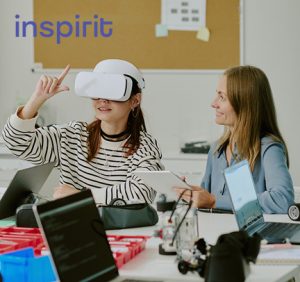
There is no better way to complement your Project-Based Learning (PBL) initiatives than by creating engaging and interactive experiences in virtual reality (VR). VR provides users with a computer-generated simulation of a 3D image or environment that can be interacted with in a seemingly real and physical way. Inspirit offers user-friendly, innovative VR headsets that […]
Teq is Headed to FETC!
Teq is off to the 2026 Future of Education Technology Conference (FETC)! Being held from January 11th to January 14th, 2026, this top-notch event is being hosted at the Orange County Convention Center in Orlando, FL! Demo innovative products, grab some swag, or say hello to the team at booth #2730. Tune in to interactive […]

Introducing the New AI Literacy and Instruction Micro-credential!
The landscape of K-12 education is rapidly evolving, driven by the emergence of Artificial Intelligence. Educators and administrators need more than just introductory knowledge; they need a structured, practical path to mastery. We are excited to announce the launch of the AI Literacy and Instruction Micro-credential Playlist! This comprehensive, seven-session video series is designed specifically […]