3 Reasons to Add micro:bit to Your STEM Curriculum
Adam Fragale
Curriculum & PD Specialist
Coding
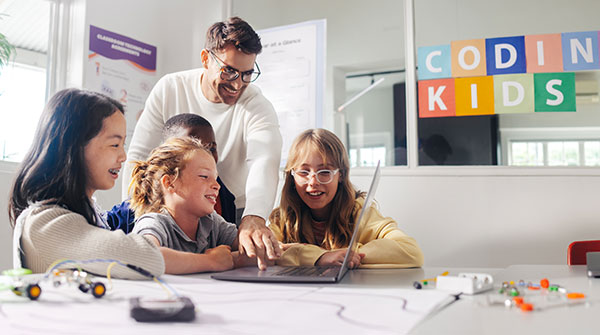
There is no denying that STEM continues to be the buzzword in classrooms and school districts around the country. As a new school year is upon us, providing students with hands-on opportunities and engaging them in learning has become a top priority. This is especially true as we are emerging from the COVID remote learning period. The focus of STEM is to build 21st century skills for tomorrow’s workforce. Plus, give students exposure to the types of jobs in areas such as coding, engineering, and computer programming. This all depends on an effective STEM curriculum, as well as tools that range from simple to complex. This is where the micro:bit can improve STEM curriculum.
micro:bit is a pocket-sized computer that will introduce your students to how hardware and software work together. The display consists of 25 LED lights, buttons, and sensors that will allow your students to interact with it physically and digitally. micro:bit is great for students ages 8+. It has a user-friendly platform that is designed for beginners and includes cool and interactive projects that merge coding and creativity. In addition to this, the micro:bit includes a multitude of features and learning opportunities. Here are three reasons to consider adding it to your STEM curriculum.
1) High versatility
Micro:bit is a great learning tool for block-based coding, Java, or Python. It can be used with Scratch and Arduino, making it useful for all levels. Whether it be in the classroom or for an after-school club, all students can experience the power of micro:bit.
2) One platform with all the content you need
When it comes to a fully-functional platform, look no further than micro:bit’s website. Here, you can find all the different code editors as well as numerous project ideas. The website focuses on giving teachers activities for students to code games and even create animations. The Microsoft MakeCode platform gives students the opportunity to use block code and JavaScript as well as including a MicroPython editor. Students will be able to see what their coded program will look like while building it. Then, they will be able to download the completed code onto the micro:bit.
3) Diverse ways to use it
The micro:bit is not limited to just your computer science class. It can be used for many different projects. For example, utilizing its A & B buttons to make a mini game controller or programming its LED lights to create patterns, words, and alerts. Additionally, it can be utilized for real-world functions such as using the sound output feature to create alarms. It even has a soil-tracking feature to determine if your plants are in need of water. These activities stretch into your math, science, and ELA classes. The micro:bit is a tool that can engage students across subject areas.
When building a STEM program that can engage students on different levels, from beginner to more advanced, the micro:bit should be the go-to tool in your arsenal. With its user-friendly website, variety of coding options, and tutorials & activities for all disciplines, teachers will easily learn how to use the device. Then, they will be able to implement it into any classroom, for any grade level, increasing student engagement and teaching valuable 21st century skills. Check out our micro:bit courses on OTIS for educators to learn more about how to use this great tool!
For more tips, tricks, and tools for teaching in and out of the classroom, check out more content on the Teq Talk blog or our YouTube channels OTIS for educators and Tequipment.
We also offer virtual professional development, training, and support with OTIS for educators. Explore the technology and strategies that spark student success — no matter where teaching or learning are happening!
Follow us on social:
 edteq
edteq  OTIS4educators | Teq Products | iBlocks
  OTIS4educators | MyTeq
  Teq
Teq
0 thoughts on “3 Reasons to Add micro:bit to Your STEM Curriculum”
Related Articles & Other Recommended Reading
Bridging the Gap to Successful Project-Based Learning with Inspirit
There is no better way to complement your Project-Based Learning (PBL) initiatives than by creating engaging and interactive experiences in virtual reality (VR). VR provides users with a computer-generated simulation of a 3D image or environment that can be interacted with in a seemingly real and physical way. Inspirit offers user-friendly, innovative VR headsets that […]
Teq is Headed to FETC!
Teq is off to the 2026 Future of Education Technology Conference (FETC)! Being held from January 11th to January 14th, 2026, this top-notch event is being hosted at the Orange County Convention Center in Orlando, FL! Demo innovative products, grab some swag, or say hello to the team at booth #2730. Tune in to interactive […]

Introducing the New AI Literacy and Instruction Micro-credential!
The landscape of K-12 education is rapidly evolving, driven by the emergence of Artificial Intelligence. Educators and administrators need more than just introductory knowledge; they need a structured, practical path to mastery. We are excited to announce the launch of the AI Literacy and Instruction Micro-credential Playlist! This comprehensive, seven-session video series is designed specifically […]