Creating Awesome Screen Recordings on Your Chromebook
Terry VanNoy
PD Specialist
News

As of early this year, Google announced some updates to their Chromebook app called Screencast. This great tool enables teachers to record tutorials and procedural videos to help students know what to do during their lessons. Students can likewise record screencasts on their Chromebooks to demonstrate their learning and do presentations using their webcam, voice, and screen actions. Read on to learn how to utilize Google Chromebook screen recordings with Chromecast!
Creating your first screencast
From the Apps Launcher icon in the lower left of the Chromebook screen, scroll through the apps available on your account and look for the green screencast icon. Tapping on this opens your screencast collection, showing any recordings you already have. Tap on the New screencast button in the upper left. Choose whether to record the entire screen or just a portion of it, then watch the countdown and start recording your screen while talking. Practice a few times with your timing. If you make a mistake, just pause for a few seconds and repeat what you meant to say. This unwanted portion of your video can be edited later. Notice, in the lower right frame of your Chromebook screen, the red ‘Stop Recording’ button and the ‘Pen’ button. Tap on the Pen button to turn on the markup tools. Long click or right click on the Pen button to choose different colors. Tap on it again to erase and turn off this feature. Check out the tutorial video below for a walkthrough of creating screencasts.
Working with the transcript
After recording and letting the video process, you’ll see it in your Screencast window. Click on the thumbnail of a video to edit the transcript, rename, and preview.
Notice that your transcript appears in a right-side panel and is timed in sections. Clicking on a section of the transcript moves the video to that point in the recording. You can click on the three dots (more menu) to skip this portion of the transcript and video.
During the recording, pause after a mistake and try again. Later, you’ll be able to find this section and skip as necessary. In the transcript settings, Google offers 12 more languages for translation. Your voice audio will still be the same, but the transcript will be translated in the language of your choice. This is great for bilingual learners and parents! Check out the tutorial video below for a walkthrough of working with transcripts.
Sharing your screencasts
Back on your Screencast dashboard, click on the three dots (more menu) to choose ‘Share.’ The video link created in this step allows only Chromebook users to view the video. In order to share your screencast to people outside of your Google domain, and for viewing on other devices, look in your Google Drive for a folder titled ‘Screencast Recordings.’ A folder for each screencast video will be there, containing each of the three files:
- The thumbnail picture used for your video as it appears in your Screencast dashboard
- Your transcript (.projector file)
- Your video (.webm file)
Your .webm video file is playable on any device, so right click on the icon and set up your sharing permissions. ‘Anyone with the link’ is best, I believe. Copy the link and post it in Google Classroom or inside an email message. Check out the tutorial video below for a walkthrough of sharing screencasts.
Classroom ideas and examples
1) Procedural Screencasts
Scenario 1: The teacher wants to show students the best ways to contribute to a Google Classroom discussion. Once the recording is started on the teacher’s Chromebook, they will jump into Google Classroom on the Stream. The goal is to show students how to find the current topic and how to add comments and feedback to each other.
2) Instructional Screencasts
Scenario 2: In a math class, the instructor wants to record some whiteboard videos of solved math problems. Using Jamboard or any web-based whiteboard application, the teacher writes out some examples from a student homework assignment, relating to the “FOIL Method.” This Screencast video can then be shared so students on Chromebooks can review it later or watch it if they missed class.
3) Student Demonstration Screencasts
Scenario 3: To demonstrate their understanding of how to use the Explore Tool in Google Docs, students record themselves adding images, footnotes, and citing sources on their writing drafts. The students talk through their process in a recorded voiceover. This will not only help the teacher see that students understand how to use the tool, but produces accountability as students work on their writing drafts.
Have fun trying out Google Chromebook screen recordings with Chromecast. Share your other ideas and success stories with us via social (see below) or email OTIS@teq.com. Looking for more Chromebook ideas? We have tons of skills videos on Chrome in our Skills section on OTIS for educators.
For more tips, tricks, and tools for teaching in and out of the classroom, check out more content on the Teq Talk blog or our YouTube channels OTIS for educators and Tequipment.
We also offer virtual professional development, training, and support with OTIS for educators. Explore the technology and strategies that spark student success — no matter where teaching or learning are happening!
Follow us on social:
 edteq
edteq  OTIS4educators | Teq Products | iBlocks
  OTIS4educators | MyTeq
  Teq
Teq
0 thoughts on “Creating Awesome Screen Recordings on Your Chromebook”
Related Articles & Other Recommended Reading
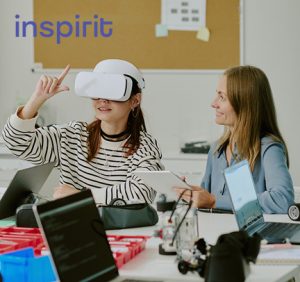
Bridging the Gap to Successful Project-Based Learning with Inspirit
There is no better way to complement your Project-Based Learning (PBL) initiatives than by creating engaging and interactive experiences in virtual reality (VR). VR provides users with a computer-generated simulation of a 3D image or environment that can be interacted with in a seemingly real and physical way. Inspirit offers user-friendly, innovative VR headsets that […]
Teq is Headed to FETC!
Teq is off to the 2026 Future of Education Technology Conference (FETC)! Being held from January 11th to January 14th, 2026, this top-notch event is being hosted at the Orange County Convention Center in Orlando, FL! Demo innovative products, grab some swag, or say hello to the team at booth #2730. Tune in to interactive […]

Introducing the New AI Literacy and Instruction Micro-credential!
The landscape of K-12 education is rapidly evolving, driven by the emergence of Artificial Intelligence. Educators and administrators need more than just introductory knowledge; they need a structured, practical path to mastery. We are excited to announce the launch of the AI Literacy and Instruction Micro-credential Playlist! This comprehensive, seven-session video series is designed specifically […]