Engaging Students with Sign Language
Michelle Hollander
Director of Educational Content
News

I recently came across a meme that I found rather inspiring. It depicted individuals that have been educating us remotely long before schools went remote. From literacy with Levar Burton’s “Reading Rainbow,” to social and emotional learning with “Mister Roger’s Neighborhood,” to art with Bob Ross, nature with Steve Irwin, and science with Bill Nye — there are so many examples! What did they do so successfully to keep us watching? They had good production quality and great concepts, of course, but most of all, they were engaging. You felt that you could connect with them wherever you were.

As educators ourselves, we’re always looking for ways to help bridge the gap and make the transition to new learning models both easier and more effective. While we don’t expect you to create a full-fledged show from your kitchen table, educators are surfacing a lot of little tips and tricks for finding ways to make socially distanced learning and video meetings more engaging. For example, a little sign language and interactive “brain breaks” can go a long way in your virtual endeavors.
The Benefits of ASL in the classroom
American Sign Language (ASL) has been used in physical classrooms to help improve focus and understanding, quietly celebrate and acknowledge student successes, and even guide direction-giving. How about bringing ASL into the socially-distanced classroom, or to your next online/video lesson?
Behavior management is an added bonus of using a collection of signs with your students — it encourages students to keep their eyes on the teacher, and also provides non-disruptive ways for students to communicate with the teacher during class. It’s also a great way to help with vocal fatigue, as neither the educator nor the students need to actually say anything if they need to use the restroom or want to communicate that they are confused. As you’ll see below, there are even silent ways to tell students to “wait” or “stop.”
ASL anywhere
ASL can certainly help bring clarity to a classroom where masks and face coverings are required, but even online classrooms can benefit from this engaging way to connect with students and hold their attention. Additionally, teaching, learning, and using these signs is a great way to help build social and emotional learning skills. Of course, you don’t need to sign everything you say, but using certain key words can make a big difference.
ASL classroom basics
The following list of words are suggested to inspire you to think about the signs that would be most beneficial for you and your students. Don’t feel limited to these alone — you can decide which will work best for your classroom whether you are in a physical classroom, fully remote, or hybrid. Another great thing about these signs is that since they are a standard language, they are not specific to individual classrooms, so you don’t need to worry about having individualized signs that might get confusing.
Some helpful words to sign with your students:
- Yes/No
- Right/Correct
- Thank you
- Wait
- Again
- Slow
- Same/Me too
- Understand/Don’t understand
- Restroom
- Applause

Resources
Finally, here are some great resources for more ideas and tools to help you get started:
- “How Using a Little Sign Language Can Improve Online Classes” [Edutopia]
- Emma Kreiner’s ASL [YouTube channel]
- ASL in the Classroom, Part 1 [YouTube video]
- ASL in the Classroom, Part 2 [YouTube video]
For more tips, tricks, and tools for teaching in and out of the classroom check out more articles on our blog.
We also offer virtual professional development, training, and remote learning support for educators with OTIS for educators. Explore the technology, tools, and strategies that can spark student success — no matter where teaching or learning are happening.
0 thoughts on “Engaging Students with Sign Language”
Related Articles & Other Recommended Reading
Bridging the Gap to Successful Project-Based Learning with Inspirit
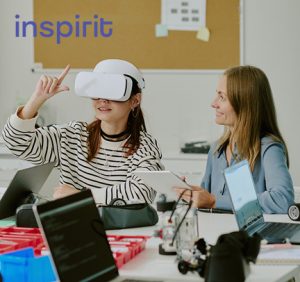
There is no better way to complement your Project-Based Learning (PBL) initiatives than by creating engaging and interactive experiences in virtual reality (VR). VR provides users with a computer-generated simulation of a 3D image or environment that can be interacted with in a seemingly real and physical way. Inspirit offers user-friendly, innovative VR headsets that […]

Teq is Headed to FETC!
Teq is off to the 2026 Future of Education Technology Conference (FETC)! Being held from January 11th to January 14th, 2026, this top-notch event is being hosted at the Orange County Convention Center in Orlando, FL! Demo innovative products, grab some swag, or say hello to the team at booth #2730. Tune in to interactive […]

Introducing the New AI Literacy and Instruction Micro-credential!
The landscape of K-12 education is rapidly evolving, driven by the emergence of Artificial Intelligence. Educators and administrators need more than just introductory knowledge; they need a structured, practical path to mastery. We are excited to announce the launch of the AI Literacy and Instruction Micro-credential Playlist! This comprehensive, seven-session video series is designed specifically […]