Using Duolingo for Remote World Language Instruction
Benjamin Cebulash
PD Specialist
News

How do we address foreign language acquisition during remote learning? There are a lot of tools out there, but Duolingo for Schools is a great platform to explore. This resource is fun, free, and full of a variety of instructional methods to enhance language practice and track student progress.
Easily create classrooms and student accounts
One of the great features of Duolingo for Schools, especially for remote teaching and learning, is the ability to create classrooms and student logins without requiring students to have an email address.
A common frustration for these types of sites is that students (especially students that just arrived in the U.S. and do not have an email/school-provided email) are required to enter an email in order to sign up. But with Duolingo, teachers can create student logins without the need of an email address, since Duolingo creates a username and password, which the teacher can then provide to students.
As the teacher, your first step is to go to schools.duolingo.com and create a teacher account. Once you have done that, you can create a virtual classroom and begin to invite students or build up your roster by typing in the students’ names.
Create and share new assignments
Another helpful feature is that teachers can send students assignments in order to learn specific vocabulary or skills. Rather than worrying about creating additional activities, find vocabulary or skills in a Duolingo set, and then assign it to your students. Here’s how.
- In your classroom, go to the Assignments tab and click New Assignment.
- Then, select your skill or lesson and assign it to your students.
- Your students will receive an email with their new assignment, or they can see it upon logging into the Duolingo for Schools website.
- In the Students tab, you will be able to see who turns in their assignments and if they are on time.
Students can also use Duolingo to practice on their own devices independently. As long as students are logging into the website, there is no reason why the fun can’t continue after instruction.
How Duolingo keeps it fun
Duolingo’s approach to content is based on real-life communication. Lessons focus on a real-life situations, like ordering food at a restaurant. Students develop the vocabulary and grammar needed to achieve that goal through many varied practices in reading, writing, listening, and speaking.
Students benefit from varied exposure to language through in-person events, interactive stories, and podcasts that provide opportunities for interaction, conversation, and reading and listening comprehension.
Duolingo also uses a balanced approach through implicit and explicit instruction, in addition to employing machine learning algorithms to serve up learning material at just the right difficulty level for each learner.
Duolingo sets are short, and students can earn points for items they get correct. Additionally, Duo the green owl is a nice little mascot that shows up to support students while they work through their assignments. Teachers can always see students’ progress in the Students tab, so it will be clear who is practicing on their own time!
In these challenging times for education, Duolingo is a great platform for language acquisition that can be easily adapted to remote learning environments. As Duolingo likes to say, it’s free language education — no hidden fees, no premium content — just free, learning fun!
For more tips, tricks, and tools for teaching in and out of the classroom check out more articles on our blog.
We also offer virtual professional development, training, and remote learning support for educators with OTIS for educators. Explore the technology, tools, and strategies that can spark student success — no matter where teaching or learning are happening.
0 thoughts on “Using Duolingo for Remote World Language Instruction”
Related Articles & Other Recommended Reading
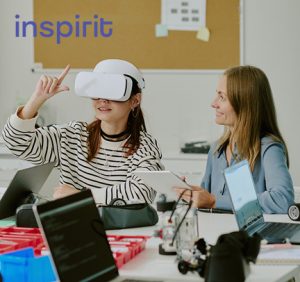
Bridging the Gap to Successful Project-Based Learning with Inspirit
There is no better way to complement your Project-Based Learning (PBL) initiatives than by creating engaging and interactive experiences in virtual reality (VR). VR provides users with a computer-generated simulation of a 3D image or environment that can be interacted with in a seemingly real and physical way. Inspirit offers user-friendly, innovative VR headsets that […]
Teq is Headed to FETC!
Teq is off to the 2026 Future of Education Technology Conference (FETC)! Being held from January 11th to January 14th, 2026, this top-notch event is being hosted at the Orange County Convention Center in Orlando, FL! Demo innovative products, grab some swag, or say hello to the team at booth #2730. Tune in to interactive […]

Introducing the New AI Literacy and Instruction Micro-credential!
The landscape of K-12 education is rapidly evolving, driven by the emergence of Artificial Intelligence. Educators and administrators need more than just introductory knowledge; they need a structured, practical path to mastery. We are excited to announce the launch of the AI Literacy and Instruction Micro-credential Playlist! This comprehensive, seven-session video series is designed specifically […]