Discover AI While Using Google with Your Students
Michelle Hollander
Director of Educational Content
News

In our last AI-related blog, we provided an overview of 5 Practical Ways AI Can be Used in Education. Here we explore the many facets of AI built into Google.
Google is a popular platform used during teaching and learning in the workplace, and even at home. There’s Google Drive for “storing, accessing, and sharing your files in one secure place,” Docs for word processing, and so much more. Built into these products are algorithms and machine learning processes that seek to make your online experience both smoother and easier. Oftentimes, we don’t even realize how much AI is used in our everyday lives.
In order to help introduce students to the role that AI plays, we suggest challenging students with a virtual scavenger hunt to identify examples of AI and thereby promote conversations that will further clarify the daily role AI plays. Who knows — students may even be inspired by future career pathways and opportunities.
Not sure how to get started? The A-Z of AI Guide provides an overview of key concepts and terms related to AI. In this blog, we will review AI features found within Google.
Built-in features
Google Search
We are constantly “Googling.” Google the term “AI” and in 0.68 seconds about 3,160,000,000 results will be returned. However, the most relevant results appear first. Why is that? Google Search not only uses algorithms but also machine learning to improve top search results and ease of access.
Discussion Question:
Do you and your students agree that the top search results are usually best? How can you make your search results more effective? (Hint: Think about Boolean operators and other advanced search options. It might just mean the difference between a search result for bulls, the animal, versus the Chicago Bulls basketball team.)
Additionally, 1 out of every 10 searches includes a misspelling, but with the aid of natural language processing (NLP), accurate results can still be found because the system is trained to understand the searcher’s intent. This is a result of Google’s Bidirectional Encoder Representations from Transformers (BERT), which put more simply, is a language understanding system.
You can also “Explore what the world is searching” — this site can also be a great conversation starter for your social studies classroom.
Gmail (and Docs)
Have you ever started typing an email and noticed that suggestions are provided for you? For instance, if you type “Good” at the beginning of your email, it is followed by a suggestion, such as “morning.” That’s because of a feature called Smart Compose. You can also find this functionality in Google Docs.
Gmail also has an additional feature called Smart Reply. If you scroll to the bottom of an email, short suggestions/choices for your reply are provided with ideas such as “Agreed!” “I agree!” and “Yes!” This is meant to save you time typing, especially when on the go.
Activity Suggestion: Do you find these options helpful? Students can even design their own “experiment” to determine the probability of successful/accurate suggestions.
Google Drive
Machine learning is also at work with Quick Access. When you open Google Drive, you are presented with the documents or files that Google predicts will be the most relevant to you at that time. These choices are based on your recent activity within Drive and even scheduled calendar meetings so you don’t have to poke around too much for the file you need.
Discussion Question: Do you or your students find this feature helpful? Why or why not?
Google Translate
Google Translate supports over 100 languages, and translations can be done through typing, talking (conversations), snapping images of text, using a phone’s camera to see instant translations of text, and writing with your finger or a stylus. Offline translations are also available, thus making this tool quite versatile when a human translator isn’t available. All users can also contribute to the community by sharing proper translations. Translate continues to adapt and learn through Google Neural Machine Translation, which has been shown to output improved results as compared to phrase-based production systems that were previously used.
Intrigued? Learn more about Google Translate’s key features and best practices by watching our “Google Translate” session on OTIS for educators.
YouTube
When working in education, making sure that students are viewing safe content is an important concern. By enabling restricted mode, Google works to filter out content that may be deemed inappropriate, mature, or offensive – and it does this with none other than machine learning.
For more information about YouTube and these other Google Products, check out our Google Micro-credentialing on OTIS for educators.
Next Steps
These are just some of the many examples of AI at work within Google. Task students with comparing these features to other platforms such as Microsoft or Apple. How are they similar or different? Use the table below.

If you’re ready to have students get hands-on with machine learning, Google also provides an entire AI portal that can be used for introducing and advancing knowledge in AI:
The world of AI is constantly changing, we can’t wait to see what you find!
Additional Resources:
0 thoughts on “Discover AI While Using Google with Your Students”
Related Articles & Other Recommended Reading
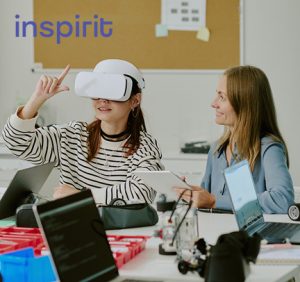
Bridging the Gap to Successful Project-Based Learning with Inspirit
There is no better way to complement your Project-Based Learning (PBL) initiatives than by creating engaging and interactive experiences in virtual reality (VR). VR provides users with a computer-generated simulation of a 3D image or environment that can be interacted with in a seemingly real and physical way. Inspirit offers user-friendly, innovative VR headsets that […]
Teq is Headed to FETC!
Teq is off to the 2026 Future of Education Technology Conference (FETC)! Being held from January 11th to January 14th, 2026, this top-notch event is being hosted at the Orange County Convention Center in Orlando, FL! Demo innovative products, grab some swag, or say hello to the team at booth #2730. Tune in to interactive […]

Introducing the New AI Literacy and Instruction Micro-credential!
The landscape of K-12 education is rapidly evolving, driven by the emergence of Artificial Intelligence. Educators and administrators need more than just introductory knowledge; they need a structured, practical path to mastery. We are excited to announce the launch of the AI Literacy and Instruction Micro-credential Playlist! This comprehensive, seven-session video series is designed specifically […]