Bring Scientific Discovery Outside the Classroom with Arduino Science Journal
Greg DaSilva
PD Consultant
Blog
Take full advantage of the sophisticated sensors found in mobile devices alongside the free Arduino Science Journal app and take scientific investigation outside the classroom. This app was previously known as the Google Science Journal but has now been taken over by Arduino. The compact form of mobile devices and the ease of use of this app will give students a sense of freedom to explore the world around them. Why do different sources of light cast different shadows? How many g’s do you experience on your favorite ride? How loud is a busy street vs. your classroom? These are just some of the questions your students can investigate using Science Journal.
Compatibility
Through using this app, your students will be able to use mobile devices, like iPads, other tablets, smartphones, and even most Chromebooks to make scientific discoveries. Such devices have a number of internal sensors including a light sensor, a GPS sensor, an accelerometer, a compass, a magnetometer, and a microphone for investigating pitch and sound intensity. External sensors can also be connected wirelessly using Bluetooth.

Pre-leaded experiments and lessons
Science Journal has a wide range of experiments that are preloaded in the app and therefore can be accessed from anywhere. To navigate to the experiments and activities while in the app, simply click on the “hamburger button” on the left hand side and locate the option for “SJ Activities.” The experiments will open in a browser tab. They are classified by module: Light, Motion, Sound, and Electricity.
After finding an experiment, guide your students to the appropriate page and instruct them to click on the plus sign in the app to begin setting up their investigation. The sensor button is where students will go to collect data using the applicable internal or external sensors. Students will select which sensors they will need and begin recording their data
Science Journal in practice
To capture data, students will simply open a new trial and click the record button. It is also possible to set “triggers” to either alert, make a note, or start/stop recording once a data threshold has been met. This option can be found by clicking the ellipsis to the right of the sensor name. Students can also take a “snapshot” which will save a single data point as a note.
While recording data, students can also add written observations and photos to better identify certain phenomena in the data collection process. All experiment data can be saved in Google Drive and can therefore easily integrate with Google Classroom.
A great pedagogical benefit of using Science Journal is the freedom that the inquiry-based learning framework will allow your students. The process of rolling it out is as easy as having students download the app and sign in. Going through the Getting Started resources with your students will ensure that everyone is correctly collecting their data. After they get their bearings, the straightforward layout of the experiments will encourage your students to make discoveries on their own. So, give Science Journal a try and see how your students’ creativity will be sparked as they explore the world around them!
For more tips, tricks, and tools for teaching in and out of the classroom, check out more articles on the Teq Talk blog.
We also offer virtual professional development, training, and remote learning support for educators with OTIS for educators. Explore the technology, tools, and strategies that can spark student success — no matter where teaching or learning are happening.
0 thoughts on “Bring Scientific Discovery Outside the Classroom with Arduino Science Journal”
Related Articles & Other Recommended Reading
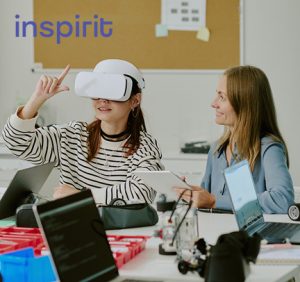
Bridging the Gap to Successful Project-Based Learning with Inspirit
There is no better way to complement your Project-Based Learning (PBL) initiatives than by creating engaging and interactive experiences in virtual reality (VR). VR provides users with a computer-generated simulation of a 3D image or environment that can be interacted with in a seemingly real and physical way. Inspirit offers user-friendly, innovative VR headsets that […]
Teq is Headed to FETC!
Teq is off to the 2026 Future of Education Technology Conference (FETC)! Being held from January 11th to January 14th, 2026, this top-notch event is being hosted at the Orange County Convention Center in Orlando, FL! Demo innovative products, grab some swag, or say hello to the team at booth #2730. Tune in to interactive […]

Introducing the New AI Literacy and Instruction Micro-credential!
The landscape of K-12 education is rapidly evolving, driven by the emergence of Artificial Intelligence. Educators and administrators need more than just introductory knowledge; they need a structured, practical path to mastery. We are excited to announce the launch of the AI Literacy and Instruction Micro-credential Playlist! This comprehensive, seven-session video series is designed specifically […]