Fostering Self-Regulation at an Early Age
Cheryl Crawford
Curriculum Specialist
Blog
Self-regulation is the ability to manage emotions and behaviors during life’s demanding moments. We are not born with the skill to self-regulate, but it begins very early in our development. As babies, we are provided with external regulation by our caregivers because we are not yet able to meet our needs. As toddlers, we experience co-regulation through our interactions with caregivers who support us in learning to self-regulate. Ultimately, we learn and develop internalized self-regulation by virtue of these interactions and experiences. For positive self-regulation to properly develop, caregivers themselves must have proper control of their executive function skills. Executive function skills are processes that help us focus our attention, follow instructions, plan, and multitask.
Why self-regulate?
According to the Center on the Developing Child at Harvard University, providing the support that children need to build self-regulation skills at home, in early care, and education programs is one of society’s most important responsibilities. Children that grow up to be adults who can monitor impulses, prioritize tasks, filter distractions, set and achieve goals, and make healthy choices will be positive contributors to society. Additionally, students that have strong regulation skills have been shown to have a higher level of academic achievement.
Key principles to support self-regulation
Early educators can support the development of self-regulation skills in children by doing the following:
- Modeling authentic self-regulation behaviors
- Developing safe environments with trusting relationships that allow for healthy risk-taking
- Establishing routines, expectations, and norms
- Creating an environment that encourages interaction amongst peers
- Providing many different opportunities to learn and practice self-regulation skills
- Discussing conflicts and ways to improve
Strategies to support self-regulation
There are a variety of ways to incorporate opportunities for children to learn self-regulation in the classroom. “Choice time,” also referred to as “learning centers,” is a popular teaching method that provides wonderful opportunities for children to practice self-regulation skills while learning. Here are some strategies you can use in the classroom:
- Utilize wait-lists to encourage patience at centers that have exceeded the allotted number of students.
- Use unit choice maps to develop self-paced learning and autonomy.
- Create self checklists and rubrics to foster metacognition and self-reliance.
- Infuse mindfulness activities and game playing at the half-way mark of center rotations to improve focus and make connections to real life.
- Allow upper elementary education students to decide how long they will stay at a particular learning center and how they will show their understanding to foster independence, voice, and choice.
To explore these and more ways to empower children with the necessary skill of self-regulation, check out our companion course here and browse our course catalog for more courses relating to the topic of self-regulation, student choice, and self-paced learning.
For more tips, tricks, and tools for teaching in and out of the classroom, check out more articles on the Teq Talk blog.
We also offer virtual professional development, training, and remote learning support for educators with OTIS for educators. Explore the technology, tools, and strategies that can spark student success — no matter where teaching or learning are happening.
0 thoughts on “Fostering Self-Regulation at an Early Age”
Related Articles & Other Recommended Reading
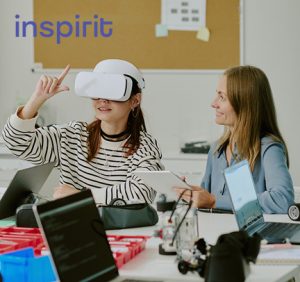
Bridging the Gap to Successful Project-Based Learning with Inspirit
There is no better way to complement your Project-Based Learning (PBL) initiatives than by creating engaging and interactive experiences in virtual reality (VR). VR provides users with a computer-generated simulation of a 3D image or environment that can be interacted with in a seemingly real and physical way. Inspirit offers user-friendly, innovative VR headsets that […]
Teq is Headed to FETC!
Teq is off to the 2026 Future of Education Technology Conference (FETC)! Being held from January 11th to January 14th, 2026, this top-notch event is being hosted at the Orange County Convention Center in Orlando, FL! Demo innovative products, grab some swag, or say hello to the team at booth #2730. Tune in to interactive […]

Introducing the New AI Literacy and Instruction Micro-credential!
The landscape of K-12 education is rapidly evolving, driven by the emergence of Artificial Intelligence. Educators and administrators need more than just introductory knowledge; they need a structured, practical path to mastery. We are excited to announce the launch of the AI Literacy and Instruction Micro-credential Playlist! This comprehensive, seven-session video series is designed specifically […]