Using Font Generators in Google
Matthew Thaxter
Director of Learning
News

Did you ever want to use different font styles to label things in Google Classroom, Google Drive, Microsoft Teams, or Microsoft Drive, so that these labels stand out? Well, there is a way to do that — with a font generator.
What is a font generator?
A font generator is a type of computer software that converts outline fonts into various types of files that can be used for websites or graphic design software. They can be used to create custom fonts, visualize font pairings and more. Typically these are font types called UNICODE — think of coded fonts that can work universally on your computer and internet.
Outline fonts are fonts that are scalable and will retain their geometrically defined shape regardless of how big or small it may be scaled.
These font generators are tools that are used mostly for social networking/media platforms like Instagram, Facebook, LinkedIn, Reddit, Snapchat, etc. Yet, these font generators can be applied to your school-based online platforms, and/or learning management systems (LMS) such as Google Classroom, Microsoft Teams, Canvas, Schoology, or Seeaaw. These can even be applied to your computer file labels.
Where can I find font generators?
The majority of these font generators are free and exist only online in a web-based format. There are a couple that can be downloaded and used, but we will focus on the web-based versions for today. Here is short list of some online font generators:
Where can I use unicodes from font generators?
Typically, one cannot copy/paste a font from Microsoft (MS) Word or Google Docs and have that font appear in the file name. Instead, to reflect a different font, you will need to have a unicode version of the text. Even if unicode text/symbols were added to a document, the code does not add itself to the computer’s font library. That means if you wanted to add more text in that same unicode font, you will have to use the online generator tool every time you wish to make changes.
Copied unicode text/emojis from font generators can be applied to following (:
- Google apps: Gmail (tags and labels), Google Classroom (names of classes, Assignments, Topics, etc.), Google Drive folder and file names, Google Doc tiles (like above), etc.
- Microsoft products: OneDrive folder and file names, Microsoft Teams names, MS Office apps (online and offline apps), etc.
- Apple products: Keynote, Pages, Numbers, Mac OS files, etc.
- Schoology
- Canvas
Look for upcoming skills videos to see how to use these font generators in your favorite educational digital tools.
For more tips, tricks, and tools for teaching in and out of the classroom, check out more articles on the Teq Talk blog.
We also offer virtual professional development, training, and remote learning support for educators with OTIS for educators. Explore the technology, tools, and strategies that can spark student success — no matter where teaching or learning are happening.
0 thoughts on “Using Font Generators in Google”
Related Articles & Other Recommended Reading
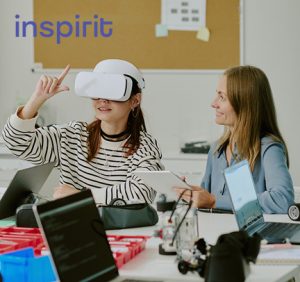
Bridging the Gap to Successful Project-Based Learning with Inspirit
There is no better way to complement your Project-Based Learning (PBL) initiatives than by creating engaging and interactive experiences in virtual reality (VR). VR provides users with a computer-generated simulation of a 3D image or environment that can be interacted with in a seemingly real and physical way. Inspirit offers user-friendly, innovative VR headsets that […]
Teq is Headed to FETC!
Teq is off to the 2026 Future of Education Technology Conference (FETC)! Being held from January 11th to January 14th, 2026, this top-notch event is being hosted at the Orange County Convention Center in Orlando, FL! Demo innovative products, grab some swag, or say hello to the team at booth #2730. Tune in to interactive […]

Introducing the New AI Literacy and Instruction Micro-credential!
The landscape of K-12 education is rapidly evolving, driven by the emergence of Artificial Intelligence. Educators and administrators need more than just introductory knowledge; they need a structured, practical path to mastery. We are excited to announce the launch of the AI Literacy and Instruction Micro-credential Playlist! This comprehensive, seven-session video series is designed specifically […]