Three Great Options for Synchronous Online Learning
Skyla Lilly
PD Specialist
News

Going virtual
When moving to remote learning, one of teachers’ biggest concerns is the loss of face time with students. While being able to share resources and assignments digitally is great, there is a lot of learning that students lose out on by not being able to speak to their teacher and each other. To help mitigate that loss of contact, however, there are some really good options for meeting in virtual classes. Below are a comparison of three of the best synchronous learning options.
Hangouts Meet
Hangouts is a G Suite app that allows for live chat and video conferencing. The most basic version of Hangouts allows you to chat one-on-one with a person or create groups of contacts and have a conference call. You can have video turned on during your call, but it’s not actually necessary and video can be turned off at any time. Additionally, participants can be muted if they are not talking to cut down on background noise or interruptions. If there are issues with hearing those who are talking, live captions are available as a great additional support.
With schools moving to online learning models in response to COVID-19, Google has made Hangouts Meet available for schools that are currently using G Suite. The features now available with this change in access are the following: increased group size capability, the ability to record videos and save them to the Drive, and the ability to live stream within a domain.
The live stream function is useful for teachers who have a lecture or lesson that they want to send out and share the link for student access. Those watching as a guest through that link cannot participate in the Hangout, however, so it’s not a feature that would be effective for a live discussion. But being able to record and save the videos is a good way of keeping records of class time, and this can be done with both live stream videos and regular Hangouts. When you’ve finished recording a session, you can save it in your G Drive and post it to your Google Classroom as a resource for absent students, or just for students to re-watch.
Quick Overview of Google Hangouts
Zoom
Zoom is similar to Skype in a lot of ways, but it lends itself well to online teaching. You can add large groups to Zoom meetings, but it also works very well for small group sessions. When you’re the host of the meeting, you can control who enters the meeting and even lock it down so nobody outside of the class can join. Like Google Hangouts, all members of the call can share their screen and annotate on what they see. As the host, teachers have the ability to turn those abilities off for their students to avoid distractions during class.
While the annotation tool is a great interactive element on Zoom, it is not the only option for allowing students more interaction during the class. Zoom also has a polling function that allows teachers to create a short quiz that they can have students take during the class. Teachers can create this before they start class or even during class if they’d like.
One especially helpful tool that is unique to Zoom is the ability to create breakout rooms. Teachers are able to build groups before the class begins when they create the schedule or during class. They can also choose group members manually, or allow Zoom to auto-sort and create random groups.
Quick Overview of Zoom
Classin
Classin is an interactive online classroom that was specifically designed for remote learning. This means that it has more options than simply just video and recording. When you’re in a class on Classin, the videos line up along the top edge and the majority of the screen is taken up by a blackboard space. The teacher will be in that main space and you can even add a second teacher to the class for co-teaching purposes. The teacher and students can all write in that space (though teachers can remove permissions for that if necessary). In addition to the main blackboard space, teachers can create individual blackboards for students. Each student then has their own space to do independent work while still being in the class all together.
The blackboards are not the only interactive element to Classin, however. Teachers can also insert timers, dice, and multiple choice clickers. The multiple choice clickers are especially useful for informal assessment throughout the class. Instead of asking a question and only getting a response from the loudest student in the call, you can have each student answer using a clicker and receive responses from everyone. If they get the answer correct, you can give them an award. You can keep track of these awards and even use them as a built-in behavior management tool.
Overall, the primary reason to consider Classin is that it has the same video capabilities of Hangouts and Zoom with more interactive options that keep the classroom experience as close to in-person as possible.
Quick Overview of Classin
For more classroom ideas and inspiration around using technology in the classroom, check out our other articles on the Teq Talk blog.
0 thoughts on “Three Great Options for Synchronous Online Learning”
Related Articles & Other Recommended Reading
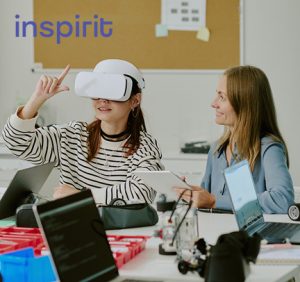
Bridging the Gap to Successful Project-Based Learning with Inspirit
There is no better way to complement your Project-Based Learning (PBL) initiatives than by creating engaging and interactive experiences in virtual reality (VR). VR provides users with a computer-generated simulation of a 3D image or environment that can be interacted with in a seemingly real and physical way. Inspirit offers user-friendly, innovative VR headsets that […]
Teq is Headed to FETC!
Teq is off to the 2026 Future of Education Technology Conference (FETC)! Being held from January 11th to January 14th, 2026, this top-notch event is being hosted at the Orange County Convention Center in Orlando, FL! Demo innovative products, grab some swag, or say hello to the team at booth #2730. Tune in to interactive […]

Introducing the New AI Literacy and Instruction Micro-credential!
The landscape of K-12 education is rapidly evolving, driven by the emergence of Artificial Intelligence. Educators and administrators need more than just introductory knowledge; they need a structured, practical path to mastery. We are excited to announce the launch of the AI Literacy and Instruction Micro-credential Playlist! This comprehensive, seven-session video series is designed specifically […]