Coding, Programming, Block-Based, Text-Based… What Does it All Mean?
Robert Abraham
Instructional Strategist
News

STEM = new terms, words, and concepts
The world of computer programming and coding can be confusing — and often intimidating. As schools continue to incorporate STEM into their curriculum, there are many new words and concepts that are often used, and sometimes misused. Whether you are a teacher looking to add to your curriculum, or a parent with a child in school, you will often hear terms like “coding,” “programming,” “block-based,” and “text-based.” They can sound pretty complicated to someone unfamiliar with the topic. Read below for some simple definitions to help you understand the basics.
Coding vs. programming
While coding and programming are very similar and the terms are often used together, there are some important differences between the two. Coding, in its simplest form, is the process of writing instructions. Programming is taking those instructions and making the target act according to them. Imagine if you are using a microwave – your role is to program the microwave to heat up your leftovers. However, someone already coded the buttons to respond a certain way when they are pressed.
Block-based vs. text-based code
 Block-based coding is very popular in schools as it offers an introduction to coding in a less intimidating way. Instead of traditional text-based programming, block-based coding involves dragging “blocks” of instructions. The most popular example of this is Scratch, a block-based language created by MIT where users drag blocks of code together as illustrated below.
Why do schools love block-based coding?
Here are some benefits of block-based coding and a clear picture of why it’s a great tool for schools.
- Low barrier of entry – You simply drag blocks and run the program. It’s easy for students (and teachers!) to do.
- Low student frustration – With block-based coding, there’s a lack of syntactical errors that come with text-based programming.
- Teaches the fundamentals – Block-based code teaches students important programming concepts such as operators, loops, events, control structures, and more, all in an easy-to-grasp syntax.
- Fosters experimentation – Another great thing about block-based coding is that it’s so easy, it begs users to try some blocks out and see what happens!
There are lots of great tools to help
Many schools are using small robots to introduce coding and most of them work with some type of block-based coding. Some examples include the Dash and Dot robots which use Blockly, and the Sphero robots which also allow students to engage with block-based coding.
For more information around instructional technology and classroom tips, check out the Teq Talk blog!
0 thoughts on “Coding, Programming, Block-Based, Text-Based… What Does it All Mean?”
Related Articles & Other Recommended Reading
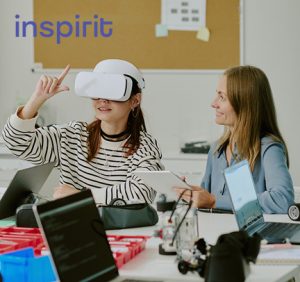
Bridging the Gap to Successful Project-Based Learning with Inspirit
There is no better way to complement your Project-Based Learning (PBL) initiatives than by creating engaging and interactive experiences in virtual reality (VR). VR provides users with a computer-generated simulation of a 3D image or environment that can be interacted with in a seemingly real and physical way. Inspirit offers user-friendly, innovative VR headsets that […]
Teq is Headed to FETC!
Teq is off to the 2026 Future of Education Technology Conference (FETC)! Being held from January 11th to January 14th, 2026, this top-notch event is being hosted at the Orange County Convention Center in Orlando, FL! Demo innovative products, grab some swag, or say hello to the team at booth #2730. Tune in to interactive […]

Introducing the New AI Literacy and Instruction Micro-credential!
The landscape of K-12 education is rapidly evolving, driven by the emergence of Artificial Intelligence. Educators and administrators need more than just introductory knowledge; they need a structured, practical path to mastery. We are excited to announce the launch of the AI Literacy and Instruction Micro-credential Playlist! This comprehensive, seven-session video series is designed specifically […]