How to Make Tessellation Tiles Using Holes & Duplicates in Tinkercad
Terry VanNoy
PD Specialist
News

Are you ready for a great classroom 3D printing and design project?
In the project outlined below, we’ll show you how to use Tinkercad (or a similar 3D design program) to create tessellation tiles that will increase your students’ literacy with CAD software — and at the same time, create printable learning aids that teach geometry, and more.
This technique uses the Hole shape in TinkerCad and makes use of duplication, grouping, and sliding techniques. The goal of the project is to create a tessellation tile that can be printed in multiples to make fitted patterns and reinforce math geometric applications. Ready to give it a try?
Here’s how to do it:
Open a new project in Tinkercad, and start with a common, tessellate-able shape such as a square (like the flattened box cube pictured here).

Step 1
The cut out part of your tessellation tile can be as simple as a triangle shape from a prism object, such as the “roof” from Tinkercad’s Basic Shapes collection. Rotate and flatten so it is at least as tall as your tile.


Step 2
Use the arrow keys to slide your shape (in my example, the green triangle) into position so the edges line up.

Step 3
Now we are going to create two parts: the red tile with the missing triangle piece taken out, and the triangle part itself to be attached on the other side (using a “translation,” to use mathspeak).
Step 4
Select both parts by clicking and dragging over everything, then make a duplicate (the keyboard shortcut for that is CTRL+D). Slide this duplicate object over to the side so both objects are side-by-side on your work plane.

Step 5
Click on the triangle piece on the left object, and make it a hole. Group both parts, and now we have our original tile with a piece taken out of it.


Step 6
 Click on the other tile piece to select it, then delete it. Make sure the remaining piece of this object, the triangle, is the same height as the tile piece. Using the arrow keys, slide it over to the other side of the red tile piece and line it up carefully.
Step 7
Select both parts and group them. Now you have the first part of your tessellation tile. Your job is now to create another piece that can be taken out, duplicated and translated to another edge of your tile. This resulting object can be printed in multiple sets and will tile together.
Instant recap – Here’s the process for your tessellation tiles:


We hope you give this project a go! Share your ideas and classroom success stories with us at training@teq.com.
If you want to learn about other types of instructional technology for your classroom, or more about 3D printing and design, take a look at our online professional development platform, Online PD. You can also learn more about Teq.
0 thoughts on “How to Make Tessellation Tiles Using Holes & Duplicates in Tinkercad”
Related Articles & Other Recommended Reading
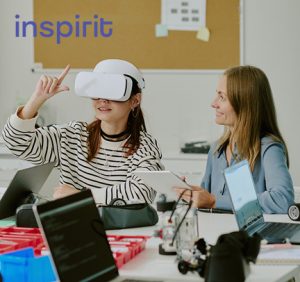
Bridging the Gap to Successful Project-Based Learning with Inspirit
There is no better way to complement your Project-Based Learning (PBL) initiatives than by creating engaging and interactive experiences in virtual reality (VR). VR provides users with a computer-generated simulation of a 3D image or environment that can be interacted with in a seemingly real and physical way. Inspirit offers user-friendly, innovative VR headsets that […]

Teq is Headed to FETC!
Teq is off to the 2026 Future of Education Technology Conference (FETC)! Being held from January 11th to January 14th, 2026, this top-notch event is being hosted at the Orange County Convention Center in Orlando, FL! Demo innovative products, grab some swag, or say hello to the team at booth #2730. Tune in to interactive […]

Introducing the New AI Literacy and Instruction Micro-credential!
The landscape of K-12 education is rapidly evolving, driven by the emergence of Artificial Intelligence. Educators and administrators need more than just introductory knowledge; they need a structured, practical path to mastery. We are excited to announce the launch of the AI Literacy and Instruction Micro-credential Playlist! This comprehensive, seven-session video series is designed specifically […]