Top 10 Ways to Celebrate Pi Day
Michelle Hollander
Director of Educational Content
News
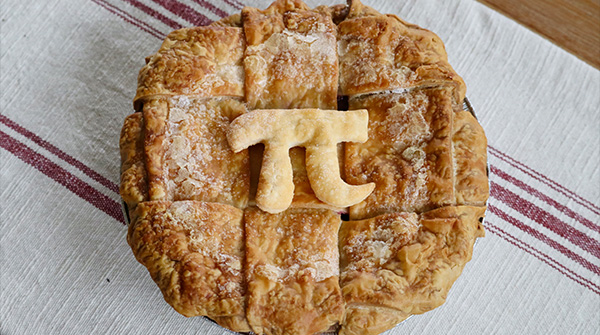
Did you know that the first official Pi Day celebration occurred in 1988 at the Exploratorium in San Francisco? In America, we celebrate on March 14th because 3.14 are the first digits of the mathematical constant known as pi. However, in areas such as the United Kingdom, people celebrate on July 22nd. Why? This is because 22/7 is a close approximation of pi, and other countries write the day first when formatting the date.
Pi, represented by the Greek letter π, is the symbol used to represent the ratio of a circle’s circumference (the distance around) to its diameter (the distance across). This ratio is constant for all circles and is approximately 3.1415926535. However, pi is an irrational number, which means that it cannot be written as a simple fraction. In fact, pi has been calculated to over 62.8 trillion digits. However, it’s an infinite decimal, which means it just keeps going!
There are a variety of ways to celebrate this holiday and make memorable Pi Day experiences for your students, but first, let’s start with the basics!
Here are a few of our favorite ways to celebrate:
1. Watch a video on calculating pi
One of my favorites is Calculating Pi with Real Pies by Numberphile! In this video, Brady Haran and his team determine how accurately they can calculate pi using hundreds of real pies. Plus, the segment’s length is 3:14!
2. Measure pi with pizza pies
You can find a variety of free downloadable printables and activities on Teq’s OTIS for educators, Educator Resources collection. Learn about diameter, circumference, and even the margin of error.

3. Read a related book
Eat Your Math Homework: Recipes for Hungry Minds, written by Ann McCallum and illustrated by Leeza Hernandez, is a cookbook that explores math in the kitchen using six simple recipes. Turn to page 32 to make a “Variable Pizza Pi” to extend the previous activity.
Cindy Neushwander also writes a fantastic series featuring Sir Cumference. On Pi Day, there isn’t a better choice than Sir Cumference and the Dragon of Pi, illustrated by Wayne Geehan. The book is geared towards students in grades 3-5, but is an excellent resource for helping students understand the concept of pi, and is great for having a little chuckle! In the story, Sir Cumference drinks a potion that turns him into a dragon. His son, Radius, has to search for the magic number (hint: pi) that will return him to his former self!
4. Make a pi chain
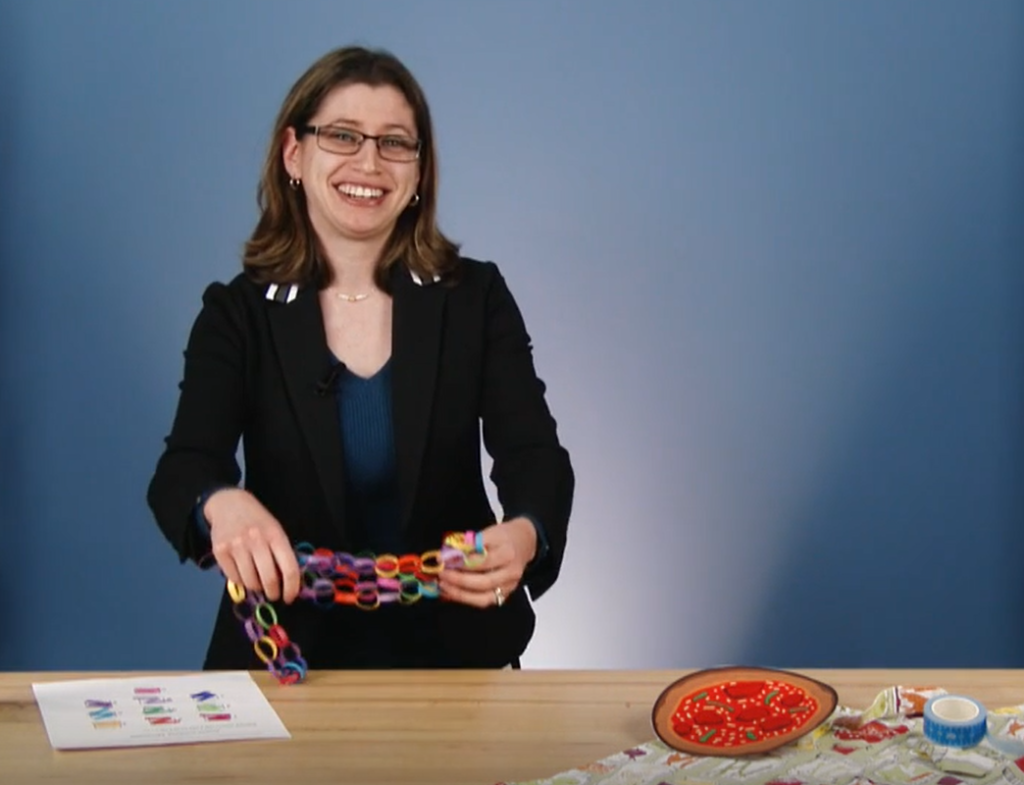
Many schools participate in making paper pi chains. In 2011, students from Monroe High School in Connecticut made a 75K link chain. Other variations include human chains, where participants wore shirts with different digits. In 2018, the College of Idaho had 600 participants for that feat.
To make a paper chain, each digit is assigned a color. Tinfoil is sometimes used to make the decimal point stand out. You can use the following Color-Coding Template to keep everything organized.
5. Design pi jewelry
Simple necklaces and bracelets following the pi chain pattern can be an alternative way for students to learn about pi. They also make a great keepsake for students to take home! You can give each digit a different color, or have students string the number of beads for each digit in different colors. For instance, three purple beads, one black or silver bead for the decimal point, one orange bead, four blue beads, etc.

6. Color a pi skyline
Pi skylines are a creative way to tie math and art together. As in the above activities, each digit is given a corresponding color. This is a great way to do graphing practice, either by hand or digitally.

7. Play Pi Day trivia!
Learn fun facts and put them to the test! Did you know? Guinness World Records indicates that the most decimal places memorized was 70K. Rajveer Meena of India recalled all of these digits in 2015, taking nearly 10 hours to recall them while blindfolded!
You can find pi fun everywhere! If you write 3.14 on a piece of paper and hold it next to the mirror, it will look like it spells “PI.E” in the mirror!
8. Write a pi-ku poem
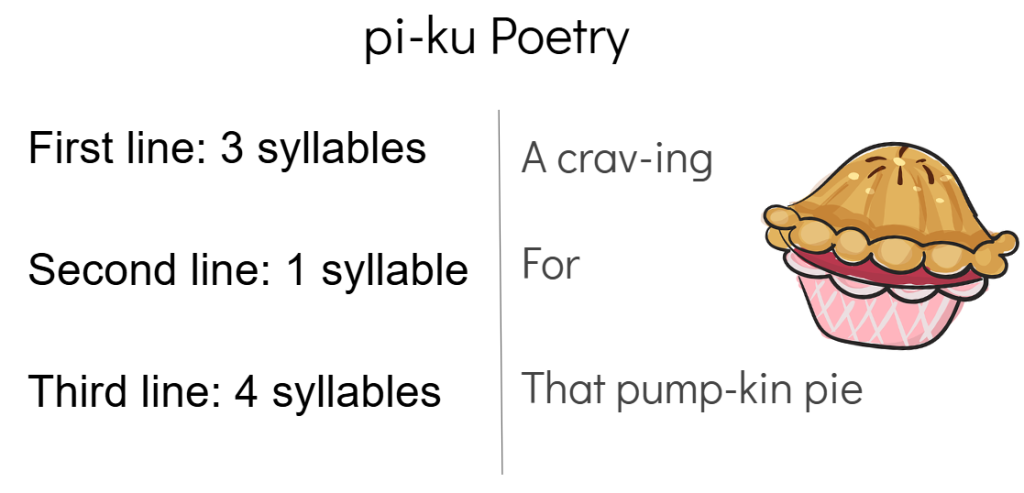
Now here’s a twist on the traditional Japanese Haiku – introducing the pi-ku! Just like the digits, the first line has three syllables, the second line has one syllable, and the third line has 4 syllables. Additionally, you can try writing a longer phrase or story in Pilish, where word lengths match the pi digits! For example, “How (3) – I (1) – want (4) – a (1) – large (5) – container (9) – of (2) – coffee (6)…”
9. Make some pi music
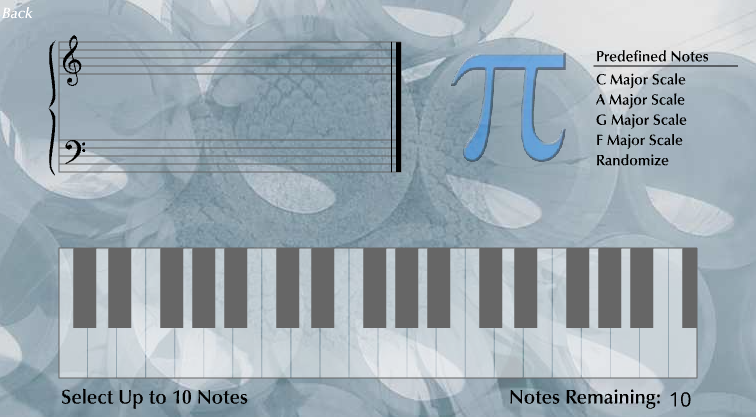
Felix Jung, a digital creative, created a Flash experiment to play the first 10K digits of pi on a keyboard. The webpage pi10k receives a lot of hits every year, particularly on Pi Day!
10. Watch an OTIS for educators course for even more inspiration!
You’ll find fully-baked pi sessions that utilize Lumio and support high school students. Check out our newest course, “Pivotal Pi Day Projects,” on OTIS for educators. We’ll explore the real-world applications of pi from space and astronomy to technology, communication, and more.
Discover all professional development opportunities, project-based learning experiences, and STEM products at Teq.com!
For more tips, tricks, and tools for teaching in and out of the classroom, check out more content on the Teq Talk blog or our YouTube channels OTIS for educators and Tequipment.
We also offer virtual professional development, training, and support with OTIS for educators. Explore the technology and strategies that spark student success — no matter where teaching or learning are happening!
Follow us on social:
 edteq
edteq  OTIS4educators | Teq Products | iBlocks
  MyTeq
MyTeq  Teq
Teq
Related Articles & Other Recommended Reading

Bridging the Gap to Successful Project-Based Learning with Inspirit
There is no better way to complement your Project-Based Learning (PBL) initiatives than by creating engaging and interactive experiences in virtual reality (VR). VR provides users with a computer-generated simulation of a 3D image or environment that can be interacted with in a seemingly real and physical way. Inspirit offers user-friendly, innovative VR headsets that […]
Teq is Headed to FETC!
Teq is off to the 2026 Future of Education Technology Conference (FETC)! Being held from January 11th to January 14th, 2026, this top-notch event is being hosted at the Orange County Convention Center in Orlando, FL! Demo innovative products, grab some swag, or say hello to the team at booth #2730. Tune in to interactive […]

Introducing the New AI Literacy and Instruction Micro-credential!
The landscape of K-12 education is rapidly evolving, driven by the emergence of Artificial Intelligence. Educators and administrators need more than just introductory knowledge; they need a structured, practical path to mastery. We are excited to announce the launch of the AI Literacy and Instruction Micro-credential Playlist! This comprehensive, seven-session video series is designed specifically […]